I recently got to see the 1973 British horror film The Wicker Man on the Big Screen. It had
been on my radar for a long time, what with my unnatural love of early 70s
transgressive films.
In a nutshell, a Scotts police sergeant (a pre-Breaker Morant Edward Woodward) travels
to the Hebridean island Summerisle, in search of a girl missing from the main
village. In the course of his investigation he discovers (not that anybody is
hiding it) that the island is populated by pre-Christian pagans, benevolently
governed by Laird Summerisle (Christopher Lee).
The premise “how would it be if a
small community never accepted Christianity, but kept their old Celtic gods?”
is a cut above standard horror templates, and I expected the easy conclusion--a Christian comes to town, and zap! He’s gotta go. But The Wicker Man surprised me by being
subtle, by going deeper. The townspeople aren’t just wicked pagans; they’re
quite happy with their lives, connected deeply to nature and the cycle of
birth, joyous living, death, and rebirth. It’s Woodward’s character that seems
pitiable, lashing out at a perfectly viable way of living, clinging to an
imported religion that brings him little joy.
The writer took pains to research the old religions of
Northern Europe and show how modern people might live using a pagan ethical
compass. It’s not a bad life. Lots of hanging out at the local pub (The Green
Man, which should be a flag to any English majors out there), drinking, and
having sex. (Not that staid, Christian sex in bedrooms with the lights off.
Think orgies in the town park.) Refreshingly, the children are brought up
knowing the Birds and the Bees, and sex is just another part of the cycle of
life.
Of course, if the crops fail…well, I think we know what has
to happen.
Christopher Lee has said that this was one of his favorite
roles, and he obviously had a marvelous time. In fact he spearheaded the
project, enlisting screenwriter Anthony Shaffer to create a script that would
be more interesting than the Hammer horror roles he had been doing for the last
decade.
Interestingly, none of the major actors are
Scotts. However, Diane Cilento was married to a Scott at the time--Sean Connery. British horror fans may recognize Ingrid
Pitt, the town librarian.
This weekend I watched My
Neighbor Totoro with a theater packed full of kids and their parents. (It
was the PSU campus theater, 5th Avenue Cinema, which meant the theater was
rather small—still, it was the fullest I’ve ever seen it, and people were
sitting on the floor in the back).
I won’t harp on the reasons you should go see Miyazaki’s
works (although you should because they’re awesome, you heathen), but a few
things came to mind.
The kids were very well-behaved—that is to say, they were
sucked into the story, and paying attention. This is interesting considering
that the spirits of the forest don’t even show up for a good 15 minutes.
Miyazaki, gratefully, does not hew to the Disney formula that demands comic sidekicks, princesses, and all that crap. He’s not
afraid to let the camera linger over a beautifully-rendered landscape or closeup—to lead the audience gently, not prod them along like a carnival barker. When the pacing in a Disney movie threatens to slack, it's time to trot out a singing candlestick or two.
While Disney animation had greatly improved by the late 80s, it still had a two-dimensional, serviceable
quality—it's slick, but not memorable. Miyazaki’s anime is gorgeous,
with lush landscapes and closeups filled with meticulous details. I
wonder if kids recognize that like the adults do.
Perhaps most importantly, in Totoro Miyazaki creates fantastic creatures that are benign,
amusing, sometimes helpful—and also a bit scary. You’re not quite sure
where they fit in the big scheme of things. None of the spirits of the forest
talk. It’s understood that these spirits have always been in the forest, and
they don’t have any truck with the religions of the humans. The father pays
respect to them with his daughters, and asks them to watch over their family.
But he does it politely, and maybe he’s not entirely being cheeky. In my mind, the best childrens’ stories are a
bit scary. That’s like catnip to a kid. Not shit-your-pants scary, but kids
want to be scared a little. This is also
what makes Spirited Away so awesome—you have no idea what the spirits are, if
they’re good, if they’re evil, if they even notice the humans at all. They Just
Are, going about business beyond mortal understanding. So you know, maybe you should treat them respectfully. Or just keep your distance.
Afterwards I asked my friend Nathan (who brought his family to the movie) what his kids thought of it. Four-year-old Evan was a bit apprehensive beforehand (because it might be scary!), but we assured him that he was totally tough enough to make it through.
This is a nice little interview with Stuart Gordon, the writer and director of Re-Animator (showing at IFS this Thursday on All Hallows' Eve). Although the camerawork is terrible, he has great things to say about making movies, the value of a good script, and how you can never lose money on a horror film if you just make it cheaply enough.
Re-Animator did well enough at the box office that director Gordon and stars Jeffrey Combs and Barbara Crampton reunited to make another Lovecraft movie--From Beyond (1986). Here's Combs talking about that experience:
Bruce Abbott was such a clean-cut dude in Re-Animator (1985):
But in the sequel Bride of Re-Animator (1989) he starts flirting with the mullet:
By the early 90s, Abbott's transformation is complete:
(For those of you with less-than-stellar German skills, that's the intro for the CBS series Dark Justice, which was part of CBS' Crimetime After Primetime slot after the 10pm news--just before the advent of late night talk shows. Interestingly, the first season was shot in Barcelona, and Abbott joined the series when production moved to Los Angeles for season two).
Steve McQueen's newest film 12 Years a Slave is going to win big at the next Academy Awards. It's an amazing, gut-wrenching film, and doesn't pull any punches by portraying slavery as pure misery, punctuated by sadism, violence, and cruelty. I looked around the theater from time to time and saw people with their heads in their hands. During some of the more horrific scenes, other patrons walked out.
I guess it took a British filmmaker to tackle the issue head-on, since we Americans have had the cinematic opportunity for over 100 years, and just can't quite get around to making a clear-eyed movie about the Peculiar Institution.
I think it’s fantastic. Alamo Drafthouse has a tough no-texting rule, and they’re sticking to their guns, even with a major
celebrity.
If texting could be done during a movie without bothering
me, I’d have no problem with it. But a cell phone screen lighting up during a
movie distracts me and pulls me out of the movie, just like somebody kicking the back of my seat, or a pair of people who insist on talking during the
movie.
For that reason, I’m anti-texting—no exceptions. If you
want to text, or operate your cell phone in any manner, leave the theater.
Based on the amount of texting I see during movies—even at
major film festivals—this is not universally accepted. Many people don’t seem
to think texting during a movie is a problem at all.
I think texting during a movie destroys the film watching
experience, and is rude to the other people in the audience. What do y’all think?
"Dune" spaceship concept by British artist Chris Foss
In exchange for a daily gourmet meal, Orson Welles was going
to play Baron Harkonnen.
Mick Jagger agreed to play Feyd.
Salvador Dali signed on to play the mad Emperor Shaddam IV.
Pink Floyd, over a meal of hamburgers, was convinced to
contribute to the soundtrack.
Moebius drew the storyboards.
H.R. Giger designed the Harkonnen Castle.
Alejandro Jodorowsky, the director of El Topo and The Holy Mountain,
was going to direct.
And it almost, almost,
happened.
Premiering last month at the Telluride Film Festival, Jodorowsky’s
Dune tells the unbelievable story of how Dune was almost made in the early 70s.
In 1974 a French consortium obtained the film rights to the
novel, and asked Alejandro Jodorowsky to direct.
Jodorowsky (left) with Sardaukar (middle)
Jodorowsky being Jodorowsky, he didn’t see this as a mere
directing project. This was a spiritual quest, and he needed Holy Warriors to
help him make "the most important picture in the history of humanity." (Jodorowsky never thinks small.) Although now in his early 80s, Jodorowsky comes through in the
interviews as an intelligent, cheerful, charismatic (and somewhat twisted)
personality large enough to charm and seduce the best talent of the day to join
his crusade.
Jodorowsky and the French backers spent an enormous amount of time and money in preproduction coming up with the look and feel of the movie. They hired British artist Chris Foss to work on spaceship and hardware design (he'd painted a number of science fiction book covers), and French illustrator/comic book artist Jean Giraud (AKA Moebius, one of the creators of Métal Hurlant, known in this country as Heavy Metal) to draw character sketches and the storyboards. H.R. Giger began working on the Harkonnen Castle (based on Moebius' storyboards). It was all compiled into an immense, full-color book of conceptual art and the complete storyboards that was bigger than a phone book. Copies of this book were given to all the major studios. Sadly, only two copies remain--and Jodorowsky owns one of them.
Character sketches by Moebius
I’m not a big fan of the modern push in documentaries to use
CGI to sex up still images, but Jodorowsky’s
Dune uses this technology well by animating Moebius’ storyboards—not a
lot, but just a bit—to give you a sense of how the film would have played out.
And the effect is riveting. You walk out of the documentary feeling pleased,
entertained, exhilarated, and sad—sad that such an amazing vision never got made into a movie.
I’ll not spoil the surprise as to why that incarnation of
the movie never made it into production, but it is heartening to see that the effort wasn’t a total
waste. Some of the proto-Dune alumni (Giger, artist Chris Foss, writer Dan O’Bannon)
were later reunited in the late 70s to work on another science fiction film—Alien.
This documentary is a fun ride, and I heartily recommend it. It looks like it's still making the festival rounds, but keep an eye out for it.
Last weekend, Nathan Bamford
(Portland’s newest IFS blog correspondent) and I took a wrong turn down by the tracks and ended up at the NOIR CITY Film Festival.
Now that the rains have returned to
Portland, the night streets are blue and oily, with reflections shattered--like
broken dreams--by passing footsteps. The City, corrupt and silent, waits
for you to make your move.
Among the highlights: newly-restored
versions of Try and Get Me! (AKA The Sound of Fury, 1951) and High Tide (1947), which were preserved
through the efforts of the festival’s parent organization, the Film Noir Foundation.
At the Telluride Film Festival this year, only a handful of
movies were projected from 35mm film—the lion’s share, of course, were digital
projections.
I was a bit puzzled when I talked to an arthouse theater
programmer at the festival, who mentioned that he was having trouble getting
35mm prints from distributors. I also noticed this problem in Portland earlier
this year, when my local theater, Cinema 21, cancelled a proposed mini film
festival because they couldn’t secure the 35mm prints.
“What’s the problem?” I asked him. “Now that most theaters
are projecting digitally, why are distributors holding onto their 35mm prints?
Shouldn’t they be handing them out freely, now that demand for celluloid is so
low?”
The programmer shook his head and explained that although
distributors refuse to say why, he believes 35mm prints are being dumped to
save on storage fees.
If true, this would be the third Great Film Purge.
The first Great Film Purge happened more or less continuously
from the beginning of film in the late 19th century to the beginning
of the Television Era in the early 1950s. Studios routinely dumped their films
in these decades because they were thought to have no commercial value at the
end of their theatrical runs.
The second Great Film Purge took place at the beginning of
the 1930s, when silent films became unpopular (and hence, unprofitable) with
the introduction of Talkies.
The Film Foundation, an organization founded by Martin
Scorsese to support film preservation and restoration, notes on its website
that “[h]alf of all American films made before 1950 and over 90%
of films made before 1929 are lost forever.” The loss of cinema history wasn’t
just bad luck—it happened on purpose.
“Most of the early films did not
survive because of wholesale junking by the studios” says film preservationist
Robert A. Harris. “There was no thought of ever saving these films. They simply
needed vault space and the materials were expensive to house.”1
Not all films were simply thrown out. In the case of older
black and white films on silver nitrate film stock, the prints were often
dissolved to recover the silver content.
This is another example that underscores how the film
industry’s rush to digital projection is only about saving the industry money.
If original prints and film elements are lost, nothing will be left to digitally transfer. Or, existing digital transfers will simply be
processed over and over again to produce “restorations”. When 8K, 16K digital projectors
become standard, will there be an option to go back to the original prints and
film elements and get the cleanest, highest-quality source possible?
Robert A. Harris again:
One final point on this subject. Once materials are
preserved properly, that does not then mean that the original nitrate should be
junked. I have to assume that today's technology will be constantly supplanted
in the future with new means of creating even higher quality preservation materials.
You never want your finest surviving asset to be a dupe when you can have the
luxury of going back to an original element.1
And yet, the industry may be purging their film
archives. Again.
1. Robert A. Harris, public hearing statement to
the National Film Preservation Board of the Library of Congress, Washington,
D.C., February 1993.
This semester I helped my friend, Gerard Donaghy, make a documentary about a local Portlander who found a cache of extremely rare 35mm Shaw Brothers kung fu films in a shuttered Vancouver theater, and now screens them locally at the Hollywood Theater.
I caught Oblivion this weekend with a friend, and found myself pleasantly surprised. Filmed in 4K, with stunning visual design, it is well worth the $15 to see in IMAX.
The plot is a bit of a hodge-podge of numerous science fiction films from the past (director Joseph Kosinski, here redeeming himself fromTron: Legacy, seems to prefer the term "homage"), but stands well on its own and keeps enough intelligent plot twists coming to maintain an effective and involving narrative throughout the two hour plus running time.
The jaw-dropping world design is ably assisted by a synth-heavy soundtrack credited to M83, as well as lush and immersive sound design. Sound is almost a character unto itself in a science fiction movie, and to Kosinki's credit, he pulls it off with aplomb.
Here's a short video covering the sound and music design of Oblivion, featuring Kosinski and several of his collaborators:
The Hollywood Theater in Portland is running Polyester Pulp: The 70s Crime Seriesover
the next few weeks. I’m fascinated by early 70s movies, probably because they
were gone by the time I was old enough to go to the movies in the late 70s.
They are beyond my living memory, and therein lies the catnip.
Dan Halsted, The Hollywood Theater’s Head Programmer, put
the series together. His comments before tonight’s initial film Charley Varrick were interesting; he
pointed out that although Film Noir as a genre is now revered, those films were
intended to be low-budget "B" crime films. The initial wave of noir films died out
by the early 60s, but crime films made a comeback in the early 70s. These films
are a different animal, in part because the death of the Hays Code allowed
filmmakers to explicitly show the sex, violence, and sadism that classical noir
could only lightly touch.
Charley Varrick is
a treat for those familiar with Siegel’s films, and those of his protégé Clint
Eastwood. Eastwood would poach some of these actors for his own 70s acting
troupe, such as John Vernon (Fletcher) and Woodrow Parfrey (Carpetbagger) in The Outlaw Josey Wales. Foremost from
Siegel’s crew is Andrew Robinson (The Scorpio Killer in Dirty Harry--and also Garak from Star Trek: Deep Space Nine).
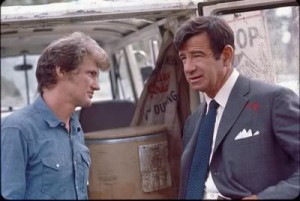
I admit, Walter Matthau seemed a bit of an odd choice as the
lead, mostly because in his early 50s, his days as a romantic lead were over.
He does bring to the screen a mix of street smarts and weariness that says “I
know the score, but this is a young man’s game, and I think it’s time to get
out.”
Perhaps that’s the key to Matthau’s casting—he’s an older
man, and his time is past, like noir itself. Siegel wanted the title of this
film to be Varrick’s company’s motto, “Last of the Independents”.
Starring: James Franco, Selena Gomez, Ashley Benson, Vanessa Hudgens, Rachel Korine, and Gucci Mane
Cinematography by: Benoît Debie
Editing by: Douglas Crise
Spring Break is kicking around in its death throes, and what a sad thing that is. I know I’ve certainly procrastinated, and for the good health of anybody, I hope you all did too! I also know that I’m not the only one who looked forward to and saw the new movie Spring Breakers. Now, if my opinion is worth 800 words (and who’s isn’t) then maybe I can save someone $10 and 94 minutes. This review has spoilers, you’ve been warned!
Walking out of Harmony Korine’s newest and most prodigal Spring Breakers, I wasn’t sure if my senses were kaput, or if what I’d seen was too garish to sense at all. The film prides itself on Korine’s exactness and style, but as a foremost provocateur, his cinematic patchwork never realizes the ambition of his ideas. It’s true that the film reaches for something and for that it deserves a little credit, but Korine’s vision is almost as unwatchable is it is hard to swallow (and unfortunately there’s none of that either).
I get it; you’re hankering for a really prime movie, but
there’s nothing playing at thecineplex you want to see. Or The Video Station is closed. Or you’re
procrastinating, and really shouldn’t leave home. (Insert excuse here.)
As it happens, there are some pretty spiffy movies on Hulu.com that their programmers, for whatever
reason, have overlooked putting behind their pay wall.
This is just a jaw-dropping film. Jean-Pierre
Melville gives the full, unspeakably bleak picture of what working in the WWII
French Resistance was like: the constant fear of being caught, the horrible
assignments of killing your own countrymen (even if they are traitors), the
coming to terms with how you’ll face your own death. There’s no sentimentality
here.
Because Charles de Gaulle was unpopular at the time of the
film’s release, it was panned in France and wasn’t released in America until
its restoration in 2006.
Plus! It stars Jean-Pierre Cassel, Vincent Cassel’s dad.
You’re not going to watch this, are you? I could say that
John Ford has a cameo as one of the Klansmen, that it was the first film to be
shown at the White House—see? Your eyes are already glazing over. Fine. If you
won’t eat the perfectly wholesome Cheerios, here’s something a little more
Count Chocula-ish:
This was one of my two favorite monster movies growing up
(the other, of course, being King Kong
Escapes, where Kong battles a mecha-Kong). The alien costumes are just
super-cool 60s, and the sexy alien played by Kumi Mizuno lingered long in my
memory.
For some reason, the beam effects are really well
done—they’re a radioactive blue, and the force fields the flying saucers
project around Godzilla and Rodan are 3-dimensional, shaded bubbles. Good job,
Toho Studios!
I know. Calm down. This is really a TV anime series. But it
beats the crap out of most movies with first-rate storytelling, character
development, and pacing. I was ready to drop out after the first three episodes
(“Jesus, is this story going anywhere?”), but my patience was well-rewarded.
Last Exile is set in a retro Steampunk future, on a colony
world named Prester. Nations fight each other with flying battleship fleets...eh, I'm not doing a good job explaining this. Just go watch a few episodes. It’s Japanese, it’s a bit weird, but it’s also amazing
storytelling, and unlike anything you’d ever see on American TV.
Christ, do you know how rare this movie is? After reading
about it and seeing snippets on YouTube, I tried to snag a copy at the Video
Station (no go). Even Netflix claimed it didn’t have a copy. (Really, Netflix?) To find it for
free, on Hulu, is truly proof that God loves us, and wants us to be happy.
Brick is a smart, well-written film
that breathes new life into the hard-boiled detective genre. Upon its release in
2005, Joseph Gordon-Levitt's acting career was losing steam, and Rian Johnson was an
aging USC graduate who had been laboring to get his script made for seven
years. Thanks to Brick, they're both A-listers, now.
*If you have fast internet. But c'mon, this the second decade of the 21st century! Even the cool new Pope has fast internet.
Walt Disney’s educational I’m No Fool series (made from 1955 to 1957) are the first projected films I can remember. In
second grade, Mrs. Galloway, who was probably at or exceeding retirement age,
gathered us around the out-of-tune upright piano and taught us to belt out rousing renditions of My Country ‘tis
of Thee and America the Beautiful.
When she tired of that (or perhaps wanted a nap behind her desk) she’d haul out the battered Korean War-era 16mm projector and spool up one of these gems:
The theme song (“Oh, I’m no fool, nosiree…”) still leaps to
mind from time to time.
I wonder if schools show these anymore. Or do they merely
encourage the children (like a Roadrunner cartoon) to stick their fingers into
light sockets, ride their bikes off cliffs, etc.?
It also occurs to me that the series is pretty death-heavy ("But fools find out / when it's too late / that they don't live so long."). How much does a second-grader really think about what the termination of existence means? On the other hand, that's what makes this series so awesome!
The series ran thusly:
I'm No Fool With A Bicycle (10/06/55)
I'm No Fool With Fire (12/01/55)
I'm No Fool As A Pedestrian (10/08/56)
I'm No Fool with Water (11/15/56)
I'm No Fool Having Fun (12/15/56)
I'm No Fool in a Car (1957)
I'm No Fool in an Emergency (1957)
I'm No Fool in Unsafe Places (1957)
I'm No Fool in Unsafe Places II (1957)
I'm No Fool on Wheels (1957)
I'm No Fool with Safety at School (1957)
I'm No Fool with Electricity (1957)
P.S. -- Mrs. Galloway, if you're reading this, I'm sorry for being such a little asshole in class. They didn't have good ADHD meds back then.
I was at Powell’s City of Books the other night, browsing
through the film section, and I picked up a book of Robert Rodriguez
interviews. Rodriguez talks about visiting Skywalker Ranch in the late 90s and
puttering around with one of Lucas’ bleeding-edge HD cameras for the first time
(George Lucas mostly filmed The Phantom
Menace on 35mm, but as a test shot two scenes in HD).
Rodriguez was already a fan of video cameras, at least to
practice with. Beginning filmmakers were better off learning their craft on
video, he advised. It was cheaper, easier to use, and easier to edit. He shot El Mariachi on 16mm, then shot
throughout the 90s and early 00s on 35mm. Clearly impressed by the HD
technology, he shot Spy Kids II and Once Upon a Time in Mexico in digital.
He never went back to film.
It’s clear in interviews from the 90s and early 00s
that not only was HD a better experience for him as a filmmaker, film itself
was kind of a drag. You were never sure, he says, what the film would look like
when it got back from the lab. It was always different, never exactly what he
intended the shot to look like. Only with the advent of HD cameras could he
look in the monitor and feel confident that what he was seeing was what he was
recording. And he could make changes on the fly given this feedback, something
else film denies the filmmaker.
He recounts how he would shoot scenes in 35mm and then with
a digital camera, and compare them side-by-side. To his surprise, sometimes the
filmed image was underwhelming to his taste. He’d take the clips on the road
with him when he gave talks, and show them to the audience. People were often
incredulous: what do you mean, 35mm is
worse? We were told it’s always better!
Rodriguez was also very much a practical effects guy early
in his career. By necessity in El
Mariachi, and by choice in later films because he felt he had control
of practical effects. By Spy Kids,
all special effects on film were getting him down. He talks about having to
scan film frames, digitally remove grain, composite the digital effects,
digitally add the film grain back, and then print the result back onto film. By
Spy Kids II, he was done with that.
He was shooting in digital, doing the lion’s share of effects digitally in post-production. It was cheaper, faster, and he felt he had more control and
creativity.
* * * * *
It’s a bit scary how clearly Rodriguez saw the future. In
the 90s he was just a young upstart, flinging rocks at the establishment. Nonlinear editing? Replacing 35mm cameras
with digital cameras? Who is this guy? This is how we do things Uptown, kid.
It's been good enough for 80 years, and it ain't gonna change.
Until it did. So fast that we’re still a bit dizzy.
The lever of change, of course, was money. The studios
didn’t care about enhanced creativity, or greater filmmaking freedom. In
digital production and post-production they saw the opportunity to save a LOT
of money. And when the technology finally matured for digital projection, they
salivated at all the money they could save not having to strike and distribute
35mm prints. All the extra control they gained over theaters was just gravy. No
longer would physical prints go floating around, outside of their direct
control. They’d know who was projecting a movie, when and where, every time.
And without a password, that video file was dead to a theater.
It’s hard to argue with Rodriguez’s line of reasoning, creatively
speaking. Filmmakers who want to shoot on film in the future are certainly
welcome to, but they’ll have a tough battle convincing miserly studios to open
up their pockets a little more. And when theaters get digital projectors, they’ll
probably junk their 35mm projectors. In five years, who will have the equipment
to project on 35mm?
For a little extra profit, the medium of film has been cast aside. I feel good about HD as a filmmaker, but I feel queasy about it as a filmgoer. It's now easier to make my sandwich, but sometimes it doesn't taste as good as it used to.
When I was an adolescent, I had a conflicted relationship with a friend. At one point, she aimed hard at my stomach with her fist. The impact was abrupt and surprising. That's kind of what watching "The House That I Live In" is like...but in a good way, the way that a great documentary can hit you hard when you don't expect it.
I have read the statistics for years now about the failed War on Drugs, prison-industrial complex, inflexible mandatory sentencing guidelines, and destructive impact of the justice system on African-American communities and lives. Judges and prison administrators are fed up. Addicts are incarcerated and remain mired in addiction. Families are destroyed. Still, at the end of the 2012 Sundance-winning documentary, "The House That I Live In," directed by Eugene Jarecki, I sat in stunned silence with a million thoughts racing in my head about the connected dots. This rarely happens to me and even less often about familiar topics.
"The House That I Live In," which the International Film Series is screening Tuesday, March 5th at 7 and 9pm, pulls together numerous different pieces of American dysfunction and inequality to present a devastating indictment of how our country deals with race and class. It sucks in the viewer with a personal story, that of how the War on Drugs has affected the family of the director's childhood housekeeper. It interweaves this narrative with interviews with people involved in the system (judges, prison officials, prison guards, etc.), historical information about the War on Drugs, interviews with a senator who helped create the situation, and other broader information.
The cherry on top of the sundae is an interview with David Simon, creator of the HBO five-season bravura meditation of the corrosive War on Drugs, "The Wire." As a journalist in Baltimore, Simon had
first-hand exposure to the Baltimore inner city and the impact of drugs on African-American communities. So, the man has cred and isn't just a Hollywood talking head. And any man who conceived of each season of his show as a novel with a meaty and important overarching theme and can write a scene where the principals communicate exclusively with various manifestations of a curse word is alright with me. Ok, sue me--I'm a fan, maybe even a rabid fan.
I thought Simon was going to offer some choice words about drugs and African-American communities. Instead, he delivers an analysis near the end of the film of how America has treated and conceives of its underclass that put the previous material of the film into a context that totally blew my mind and brought up questions for which I have no answers.
In the waning of the empire, there are no endless opportunities and brighter days for everyone, much less our poor and working class. In an era of budget-cutting and austerity, educational institutions, never stellar in poorer communities,cannot provide the way out. Hell, we are even cutting back food subsidies to poor mothers and their infants and toddlers. And there are politicians who are cheering on these measures. Simple reality in this country keeps falling into a bad case of surrealism. It stands to reason that films that put the pieces together, rather than plunge me into escapism, blow my mind.
I know this probably reads more like a lefty screed and less like cinematic analysis. But when it comes down it, I believe that cinema is at its best when it opens my mind and makes me wonder about the world. Sometimes, this takes the form of a fictional aesthetically beautiful fantasy, like "Holy Motors" where I found myself contemplating reinvention and the protean nature of identity and performance. Other times, it is a documentary that slaps me across the face, holds me rapt with its varied way of presenting vivid and important information, and haunts me with its ideas.
The end result is this is a film that I want everyone I know to see. It's important, provocative in the best sense of the word, and worth the time. Hopefully, you can come up with better solutions to the issues that it brings up than I have.
If there's only one film that you see at the IFS this semester (and given the quality of the offerings, that would be a shame), show up for this film and invite your friends to come with you.