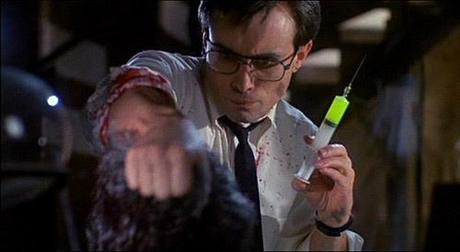
My local theater recently ran a Stanley Kubrick mini-fest (Dr. Strangelove, 2001, A Clockwork Orange,
Barry Lyndon).While watching Ryan O’Neal plod woodenly through the Seven Years' War, it hit me
once again: why did Kubrick often choose such bland, terrible lead actors?
He didn’t cast that way all the time (think Peter Sellers in
Lolita and Dr. Strangelove, Jack Nicholson in The Shining, and terrifically vibrant Malcolm McDowell in A Clockwork Orange), but he often did
(O’Neal, Keir Dullea in 2001, Matthew
Modine in Full Metal Jacket, Tom
Cruise in Eyes Wide Shut).
This question has always vexed me about Kubrick. Recently
in Powell's film section, I was reading John Baxter’s Stanley Kubrick: A Biography and stumbled upon Baxter’s
explanation. Kubrick, he opines, didn’t want his movies to look too real. He
liked them to feel abstract, removed from normal experience. He felt that bad
actors (or good actors exhausted and wigged out from 20-30 consecutive takes) gave an
off-kilter performance that contributed to the feeling of abstraction.
I don’t know how I feel about this explanation. Nobody ever
accused Kubrick of being sloppy or careless, so he obviously put a lot of
thought into what lead actor he wanted, and the performance he wanted to get. To me, these bland-tacular performances
pull me out of the movie, and I end up thinking about the terrible acting
while the movie rolls on.
What do you think? Does anybody have a better explanation?
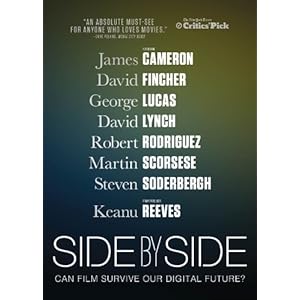
Given the trend of digital projection posts on the blog, I thought it might be pertinent to mention Keanu Reeves' recent documentary, Side by Side, on the transition of cinema from primarily 35mm film to digital both in production and presentation. Reeves speaks to a huge number of modern directors, from Martin Scorcese to David Lynch to Lars von Triers.
Salon published a terrific interview with Reeves (who is transitioning to producing and directing at this stage in his career) in September , which you can find here.
If all this talk of digital filmmaking and projecting leaves you cold, well, you can always get into the holiday spirit by watching Christopher Walken deliver the most Christopher Walken performance of all time:
I am sitting at my desk with iTunes open and listening to
Ravi Shankar. If you download his
music, one track could very easily be over 28 minutes. That’s a quarter of the time it takes to watch a
feature-length film or half of an hour-long documentary. 28 minutes could be a journey, a
distance, an entire movement. If
you watch the music instead, it’s a cinematic birth. Maybe it has five acts?
There could be a pre-amble, there could be a birth, a death, a walk in the
park, voices in the chorus, landscape unfolding from the window of a train,
beautiful love making in daylight, exquisite meals happening, contemplations,
conversations, dreams, desires of a young man named Apu? Mahatma? dances in the
court with the Indian girls, intrigue, murder, intoxications of all kinds and
then the denouement, the rest and relaxation, and sleep…for another departure
is around the corner.
David Barsamian
I don’t know much about ragas, but David Barsamian
does. You hear his voice on KGNU
and 125 other radio stations. He
is the founder and director of “Alternative Radio” and maybe you see him riding
his bicycle around town or shopping at Ideal. He never seems to age. He knows how to listen to a raga and
he knows how to talk about it.
Really. So go to him if you
need the facts. I only have the
stories the music can tell me.
Waning Crescent
Ravi passed on December 11 - that was Tuesday this
week. Tuesday was a waning
crescent at 4.6% in Scorpio. The
moonrise was at 5:11am and it set at 3:17pm. They say being born is like the rising sun and dying is like
the setting moon. Ravi was
92. It’s wonderful to live that
long, right? He died in San Diego, California. Have you ever been to San Diego? The light is soft and the air is infused with seawater.
There are rosemary plants the size of bushes along the sidewalks - unthinkable
here in tough-to-grow-rosemary Colorado. Dr. Seuss lived in San Diego. It is the land of Horton, that famous
cat with his hat, and grumpy Grinch. The flora and fauna of San Diego could
have easily inspired a doctor like Seuss.
Can’t you see Ravi’s music flowing out of San Deigo, moving
Lorax Scenery
with the
ocean air currents and slowly, magically, growing? It’s moving across the continent and kissing you with
tenderness and planting a story in your mind. It’s bidding us farewell, for now.
It’s cinematic music.
I’m not alone in re-imagining his music for the 24fps crowd.
Richard Attenborough and Satyajit Ray worked with Ravi and I’m sure Wes
Anderson’s “The Darjeeling Limited” has some roots in Ravi.
Ravi was nominated for an Academy Award for his score of
Richard Attenborough’s “Gandhi” in
1982. He lost to John
Williams, for E.T.
Satyajit Ray
He composed the music for Satyajit Ray’s “Apu Trilogy”. Have you seen these films? They are so beautiful. I mean really stunning. You watch one of his films and feel the
tremendous burden of love, death, desire, and peace. You have the realization that sadness and happiness are a
construction. You will never know
the whole story of why. It is
better to be at peace than to struggle.
You are finally allowed to say, with your whole heart, “Everything will
be ok, no matter what!” And that
is Ravi’s music too.
Ravi composed the music for “A Chairy Tale,” which was
nominated for an Academy Award for best live action short in 1957.
And of course we all know about the mutual love affair of
Ravi and George. As my sister said
in her recent FB status: “The great band in [the] sky keeps gettin' better 'n'
better... It's just down here, that it seems a bit empty...”
Ravi, I’ll be listening and watching your music. Peace to
you on the journey.
My neighborhood theater is now showing a Kubrick
retrospective. My first thought was “Ah! Four Kubrick masterpieces on The Big
Screen, in 35mm!”
Not quite.
The theater’s website explains “ALL FILMS IN 35MM / EXCEPT
‘DR. STRANGELOVE’ / DIGITAL RESTORATION (DCP)”.
So, it is projecting Dr.
Strangelove digitally (using the commercial Digital Cinema Package
standard). Which “restoration” is this? Is it really a “restored” version, or
was it just scanned and cleaned up a bit?
They do not say.
I would hope that it’s some fancy, 4K-resolution Criterion
Collection-or-better restoration, but unless the theater tells me, I can only
noodle around on the web and guess. (Or I could call the theater—but why
wouldn’t they just put this information on their website in the first place?)
This is the Brave New World of digital projection, which is
basically caveat emptor. Anything can be digitally projected, so how do you
know what your hard-earned dollars are paying for? DVD quality? 2K? 4K? A
restoration by a reputable company that specializes in such work?
A few months ago I dropped in on another theater in Portland
that was showing Casablanca for free.
It turned out to be DVD quality, projected in the wrong aspect ratio.
This problem has also been creeping into film festivals for
the past few years. The Telluride Film Festival now routinely charges at least twenty dollars (much more if
you’re a passholder) for a digitally-projected movie—maybe it’s a classic that
you very much looked forward to seeing in the native format. But TFF won’t tell
you on their program how it’s being projected.
And this is unacceptable. Without knowing how a movie is
being projected, how can you make an informed decision as to whether or not the
movie experience is worth the asking price?
Film festivals are trying to get away with withholding this
information because it’s cheaper for them to project digitally, and they hope
only a few people will get pissed off enough to demand a refund. It’s a cold,
calculated business decision. But, without telling a potential customer upfront
exactly what is being shown, and in what format, it is dishonest.
I don’t think my local theater is trying to be shady, but
this half-assed way of describing what exactly they’re projecting is probably
going to be the norm, unless we as cinephiles demand they do better. If theater
owners realize that customers are withholding dollars because they’re not
getting enough information, they’ll hop right on that.
And, oh yeah:
THE INTERNATIONAL FILM SERIES ALWAYS TELLS YOU HOW THEIR FILMS
ARE PROJECTED!!!
Because that’s the kind of stand-up dudes they
are.
Below are two essays and one excerpt that were brought to my attention by David Bordwell. The first two are links to articles written in 1999 by Godfrey Cheshire that very prescient. (Long, but worth the read.)
Part 2 of of Cheshire's "Decay of Cinema" can be found here (some overlap here, but if you skip down to the 12th paragraph that starts off with 'When people first saw film..' you can pick up the thread from there):
More recently, Tarantino also weighed in on the subject of cinema being dead, because it's now mutated into a different beast altogether ("television in public"):
Tarantino: No, not at all. But I don't intend to be a director deep into my old age.
Russell: Wait a minute. That's bad news for everybody.
Tarantino: I'll
probably just be a writer, or I'll just write novels, and I'll write
film literature and film books and subtextual film criticism, things
like that.
THR: Why do you plan to make that change?
Tarantino: Well,
part of the reason I'm feeling this way is, I can't stand all this
digital stuff. This is not what I signed up for. Even the fact that
digital presentation is the way it is right now -- I mean, it's
television in public, it's just television in public. That's how I feel
about it. I came into this for film.
Affleck: Digital projection as well? 'Cause film's over. I mean, there are no film projectors in the country.
Tarantino: Yeah, and that's why --
Russell: I won't shoot digital.
Tarantino: No, I'm not talking about shooting digital.
Russell: Do you shoot digital?
Tarantino: No,
I hate that stuff. I shoot film. But to me, even digital projection is
-- it's over, as far as I'm concerned. It's over. So if I'm gonna do TV
in public, I'd rather just write one of my big scripts and do it as a
miniseries for HBO, and then I don't have the time pressure that I'm
always under, and I get to actually use all the script. I always write
these huge scripts that I have to kind of -- my scripts aren't like
blueprints. They're not novels, but they're novels written with script
format. And so I'm adapting the script into a movie every day. The one
movie that I was actually able to use everything -- where you actually
have the entire breadth of what I spent a year writing -- was the two Kill Bill movies
'cause it's two movies. So if I'm gonna do another big epic thing
again, it'll probably be like a six-hour miniseries or something.''
Holy Motors 115 minutes Writer and Director: Leos Carax Starring: Denis Levant, Edith Scob, Eva Mendes, Kylie
Minogue, Michel Piccoli Cinematography: Caroline Champetier Editor: Nelly Quettier
Eva Mendes and Denis Lavant
Kylie Minogue
Sadly, I haven’t seen any of Leos Carax’s other films. Perhaps you’ve seen "Boy Meets Girl", "Mauvais Sang", or "The Lovers on a Bridge"?
I’ll be sure to look for them after seeing his latest effort, "Holy Motors". Carax
is a Parisian; it’s in his blood, his vision, humor, style and all over this film. Paris is that grand city of lights
where stories unfurl in the dark and, if you are lucky, you witness something
magical, incredible and delicious without a ribbon of sunlight to adorn it.
Even the famous Poilâne bread is baked in the middle of the night.
Oscar (Denis Lavant) is on an journey of episodic delight. I understand that Carax has many muses and Denis Lavant is
one of them. He is in almost every
scene and possesses the physical agility
of a tree monkey. He's fun to watch. It’s a smooth and even performance in a film that is nothing but
bumpy and surprising.
Carax
himself opens the film. After
waking from a dream (or are we entering his dream?) his hand turns into an
allen wrench and allows him to open a secret door to a movie theater where an
audience is fast asleep while a movie unspools.
The camera is on the balcony with him in the back row. Has he revealed
himself to us? Are we that
audience in his dream? Is this an
invitation to go on a ride? There are
eleven episodic tales depicted in "Holy Motors" and we begin in the pre-dusk
hours as an industrialist in suburban Paris kisses his children good night and
is whisked into his waiting limousine by Madame Celine (Edith Scob), his sexy
and mature chauffeur, who doubles as a guardian angel and confidante.
It’s worth noting that this film is based on a short that Carax
made called "Actors". I haven’t seen this film, but just the title helps you
understand the edifice that Carax is constructing with "Holy Motors". Although we are taken on a episodic
journey, we are essentially always in one spot, with the actor, as he delves into one character after another. After he is killed, dies of
natural causes, or the script spits him out, he returns to the limousine where
Madame Celine puts him back together again until his next part. And the ride continues.
The transformations that we witness are enhanced by make up, hair
pieces, CGI effects, prosthetic limbs, and fabulous costumes. As we become engaged, we
realize it is make-believe, movie magic,
dramatic storytelling and pure fantasy that is sucking us under. Take special note of a dry and speechless performance from Eva Mendes in a killer episode of almost pornographic devilish delights and later, a key scene with Kylie Minogue where the artificial wall within a
wall is broken even further.
During the screening I attended in New York at the Walter
Reade Theater at Lincoln Center, an elderly couple seated in front of us left after the Eva Mendes scene.
And shortly after, a few other couples found the exit doors too. It is not easy storytelling,
exactly because the story is outside of the film. You are not witnessing a
traditional linear plot for 115 minutes. You are on the
fringe, where it can be a bit more interesting sometimes.
As an analogy, think of a farmer’s market as a movie. The beginning, middle and end of the farmer’s market is a linear story.
You are engaged in the traditional structure of the story. Then go to just one
vendor and witness a single
player (or actor) of the farmer’s market as a man, a husband, a father, a son,
a brother, an activist, a farmer and so on. This human being is all of these things. Yet, when you pass
his or her stand, you see only the farmer selling vegetables as part of the
greater whole of the “film” that we have constructed. In "Holy Motors", you are seeing the actor embody the man, the
farmer, the husband and so on.
There is no edifice. There is no place to be something other than the
role, the part, the gig, the performance. If you love the construction of movies, as I do, you’ll
appreciate the edifice coming apart at the seams and revealing something
humorous, playful, and spry.
And as you witness this, remember what actors do, what kind of risks they're willing to take at the beginning of a career and how they make
decisions about a particular role. And then think about aging actors who have fewer and fewer parts and want to take less and less risks towards the end of a rambunctious and creative career. You can tell they did a
movie just to take the money and run.
If you need help, imdb Nicolas Cage.
Acting is a curious art. When I’ve met actors, I notice that they don’t have
much to say, they don’t take up very much room psychologically and they have
the ability to blend in quite well, if they are not overly famous. When an actor is really good, it’s as if
they have that magical and temporal ability (mixed with a tremendous amount of insecurity) to be a form that is ready and willing
to be filled by a story, a character, or a fictional personality for a brief moment
in time, perhaps just long enough for a director and confident personality like Carax to capture what
it’s like and share it with us, the audience in the dream.
As an aside, there were moments of transcendental filmmaking for me in "Holy Motors" that can't be explained in a review because they had no beginning, no middle and no end. They existed and were gone - all for no apparent reason except to celebrate the freakish and wonderful moments that happen when people move from one space to another.
Go see the "Holy Motors" when it plays at IFS and let me know what you think! umorera (at) gmail dot com.




.jpg?film_rn=11715)