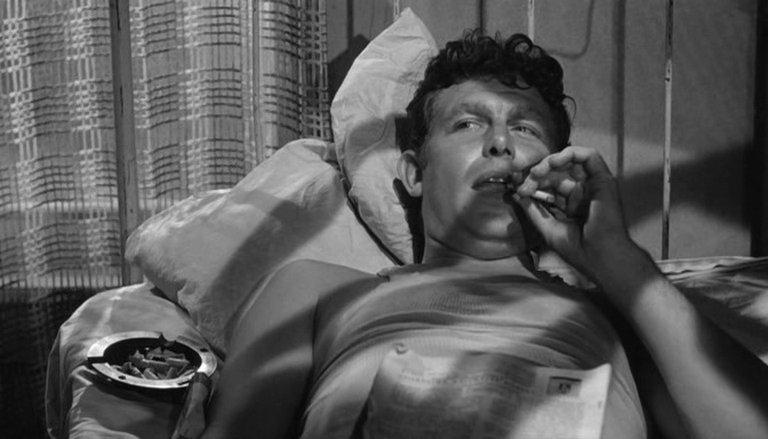
That is to say, his character "Lonesome Rhodes" is in 1957's A Face in the Crowd, directed by Elia
Kazan.
Neglected by audiences and somewhat panned by critics upon
its release, it has steadily gained stature over the years, and rightly so. I
can’t say I’m totally up on all of Andy Griffith’s movie roles, but I wouldn’t
be surprised if this was his high water mark as an actor.
Over the course of the movie, Griffith’s character, Rhodes,
is rescued from a small-town Arkansas jail by an impossibly young and
fresh-faced Patricia Neal, whose character Marcia Jeffries is scouting talent for her “A Face in the Crowd” program on her uncle’sradio station. Horse trading cooperation for
an early release, Griffith spews forth a folksy country-boy banter and strums a
song on his ‘ol gih-tar. Rhodes (who doesn’t know, or just doesn’t want to
reveal, his first name) is dubbed “Lonesome” on the spot by Jeffries.
The folks love him, and a star (and also a monster) is born.
It turns out Lonesome Rhodes’ hayseed shtick is enormously
popular, and he finds he can make audiences do just about anything. He derails
the local sheriff’s political ambitions for mayor. He gets the good folks of
Memphis to contribute their quarters to a black woman who needs a new home. He
gets his ever-growing audience to start buying a worthless energy pill (this
was before worthless energy drinks, and good-as-gold Viagra) called Vitajex.
People take notice. Powerful people. And then Rhodes starts
setting his own course.
Without blowing the whole movie for you, let’s just say that Rhodes
isn’t too interested in the common good. He’s interested in A#1, and how to get
his favorite person to the top, with the population of America hanging on his
every word, ready to do his bidding. A lot of people get hurt in the process,
and every time Griffith flings some emotional dung in Patricia Neal’s face,
your heart breaks along with hers.
Although Kazan is a bit ham-fisted and on the nose in
certain scenes, it’s still a powerful movie today, and would have been
astonishing when it was released in the late 50s. At a time when TV was starting to pick up
steam, Kazan clearly saw the power of the medium, and how that power could be
twisted to vile ends.
It's a damned fine movie. Go rent it. You’ll never see Sheriff Taylor the same way
again.
"I've always trusted that what I think is funny they
will laugh at, what I think is moving will move them, what feels ...
interesting [to me], they will find interesting. I don't find anything
interesting about a gun. A gun is there to threaten or kill. ... A gun is
rarely used in film in a way that feels like ... life." Dustin Hoffman
“Zero Dark Thirty” just opened up in Boulder last
weekend. I went to a matinee
screening which was packed with young college-aged men. The protagonist, played by Jessica Chastain, was named Maya, which is Sanskrit for illusion.
Chastain also stars in Malick’s “The Tree of Life” opposite Brad Pitt
and from looking at her imdb profile, she’s done a lot of television. She had a minor role in “The Help” as
Celia Foote, the perky wife who hires Minny to show her how to cook real Fried Chicken.
Kathyrn Bigelow, the director, likes to direct big action
flicks. Have you seen “Point Break” with Patrick Swayze and Keanu Reeves? The plot revolves around surfing and busting into banks and
stealing money, I’m simplifying it of course. She also directed “Strange Days” one of the few films I’ve
ever walked out of, dragging my boyfriend at the time with me. I saw “The Hurt Locker” which won best
picture in 2011, about a man obsessed with detonating bombs, again I’m
simplifying the story for the sake of getting to my point. Bigelow likes action. She likes to keep the guns and the
bombs in the frame and the threat they represent as a constant presence.
IFS is not screening “Zero Dark Thirty” so this blog piece
is purely my attempt to share some observations about the movie and its
director from the perspective of a woman who makes films, watches films and
thinks a lot, maybe too much. I should
be clear, I love action movies.
One of my favorite action films is “The Fifth Element” with Bruce Willis
and directed by Luc Besson. It is true that the "The Fifth Element" is on the comical and goofy side of the genre but it’s
packed with science fiction, romance, CGI effects, wacky characters and heroic
figures. The story still contains the classic
save-the-world-from-the-evil-empire only with a lot of zany detours and ridiculous and
implausible exposition. But isn’t that what every James Bond movie is about? Or any dark and serious action flick? In “Zero Dark Thirty” our hero
is a heroine named “illusion” and she saves the world from Osama Bin Laden
(OBL) the evil Al Qaeda dictator who paid for 9/11 and is behind the successful
US campaign to have every passenger disrobe before boarding a plane. Only it’s
for real. This is based on truth,
it’s not a ‘Skyfall” or a hobbit or a Bruce Willis "Die Hard" movie.
So what was I seeing and experiencing while I watched this
film? First I wanted to know if
Maya was real and turns out she is but maybe her name is “Jen” and she is
definitely still undercover. This is a real person recruited into the CIA from
either high school or college to fight terrorism. Very interesting.
And how did it feel to watch a film from the perspective of a female
heroine who was putting the pieces together of a grand scale murder mystery investigation?
Chastain does a wonderful job of letting her face do all the work. She did that in “The Tree of Life”
also…I don’t remember one full sentence coming out of her mouth; it was
whispers, happy yelps, fearful screams, gentle seductive smiles, angry or sad
tears but very few actual sentences. To a lesser extent, she does that here too. She eats a lot of junk food and she
thinks, sleuths, deduces, and finally is overwhelmed by her own results. My
overall impression is of someone who does literally nothing else but detective
work; she has no friends, is smart enough not to take on a lover, and ingests a
copious amount of information.
So, I ask myself again, what am I watching? The film is set up like an episodic
television show and is poorly crafted to some extent. The torture scenes
depicted in the film (waterboarding) have been heavily debated all over the
blogosphere, the press and on TV so there’s no need for me to discuss
that. We are being carried on
Chastain’s brows; they will tell us if we’re up or down, angry or sad,
terrified or confident and so on. So, based on assumption, through Chastain we
find Bigelow. What is Bigelow
doing with this movie? Why did she
choose the gaze of a female?
Knowing that it’s based on a real person lubricates the decision, but I
think Bigelow might have created the persona of Maya anyway. Maya is tough,
insubordinate, and confident and possesses providence. She has no existence
outside of the mission. She is a
one-pointed animal.
To be a female action director in Hollywood, to be the first
woman to win best picture, to be married to James Cameron for three years, to
be able to direct pictures that are gritty, hard and threatening, to raise the
money to make these films, to deal with the criticism that comes with them, to
make a film that depicts extensive torture, to steadily build a life of wanting
to be in that life you have to be an animal. You have to be conniving, tough, insubordinate, and
confident and possess providence.
There is no way out of it.
If you don’t have those qualities you don’t make movies and you
certainly don’t make Hollywood movies. I would pose that we are watching
Kathryn Bigelow as Jessica Chastain as Maya. Because, as a movie, as piece of
art, as a reenactment of the OBL takedown, this is not much of a movie. But as an anatomical dissection of what
it takes to be a woman who makes Hollywood action movies, it’s beyond
accurate. You have to know that
Bigelow identifies with Maya, embodies her, breathes the same air and screams
at the same a#@holes every day that Maya does. Maya does a beautiful job of telling people off and the
satisfaction of it is palpable because Bigelow knows how to depict it
beautifully.
As someone who has worked in the Hollywood machine for some
years, been behind the assistant desks of Michael Shamberg and Stacy Sher, and
other monsters, I recognize a true heroine when I see one. This film is a battle cry it is not a
film. It is a beating on the chest
and taking up of weapons. Ok KB, I
get it. Are you done proclaiming?
Because I’d like to see what you’ve really got. Can Bigelow be the heroine and save the
Hollywood filmmaking machine from certain destruction? I don’t think we have to know or that
it’s all that interesting. What
would be interesting is if she pulled a Marc Forster and did a “Finding Neverland”. Forster went from doing a hard and dark film called “Monsters Ball”
to the literary and poignant true story of J.M. Barrie that was elegant, had a
gorgeous script and was well crafted and performed. I’m not saying she shouldn’t do an action film, which
she obviously wants to do, I’m saying she could tone it down, soften it up,
change the story from a battle cry to a peaceful cry and show us another side
of her skill set and talent. Can she soften up and remove the threat of a
weapon or two? Can she craft
something beautiful, precise and elegant that is moving and touching and not
bloody and murderous?
It is possible that Hollywood has gotten to her and it’s too
late, but I hope not. KB,
step outside the box, step outside the 18 to 25 year-old male audience sweet
spot, step into a film about life without a weapon, I dare you.
Recently I sat down with ex-Boulderite actor, producer and
director Judson Webb who’s now living in Falun, Sweden to talk about his part
in the Boulder produced award-winning film “Somewhere West”, his experiences
with the Boulder theater scene, and his new theater company, Everything Theater
Company, www.everythingtheatrecompany.com (for the remainder of this article abbreviated to ETC).
To prep me for our conversation Judson sent me his manifesto
for ETC entitled “An Operational Manifesto for Training Makers of Enlightened
Theater”. I was immediately
interested. It’s a two-page
document that deftly covers the vision of ETC, which Judson runs with his wife
Kjesti. Between the two of them, they have over 20 years of experience and
offer services for corporate training, theater for adults and children and
produce original theater and film.
Here is an excerpt from the first paragraph:
With a rebellious sense of humor we
reject the idea that artists of any kind must be overly neurotic, addicted or
dysfunctional in order to create. We believe that theatre artists should seek
to become beacons of joyfully awakened, high-functioning expressiveness as it is
their job to be clear conduits for communicating the mysteries of being human.
To accomplish this we see the cultivation and practice of deep self-awareness
as central to the training of theatre artists. We define spirituality as “our
relationship to the unknown”. We strive for unabashed hilarity, technical
mastery, innovation and vulnerability on our path towards an enlightened
theatre.
Sounds pretty great, doesn’t it? Judson was heavily involved
in the film “Somewhere West”, directed by David Marek, who holds an MFA in Film
Production from the University of Colorado. The film has won numerous awards on the festival circuit and
has become a testament for independent first-time feature filmmakers.
Trailer for "Somewhere West"
During our interview I wanted to know about Judson’s manifesto
and in particular his ability to create environments for “…hilarity, technical
mastery, innovation and vulnerability…” Judson very clearly said that
collaboration was key but really there were two main ingredients. He explains, “"Somewhere West", that was
30 days in an RV about half of those days were grueling. We had nine people
doing 20 people’s work. We were driving from location to location. We covered
about 5,000 miles in those 30 days. We were shooting in all conditions. We were ducking permits and doing it
guerrilla style and re-writing the script with no chance to re-shoot so we had
to get it as right as possible in the moment.”
“What we came out with wasn’t perfect by any stretch. Had we
had more time and more money we could have made it better but still what we
came out with was Herculean. In its own way it’s done very well. If we had all
hated each other it would have been over before it began! So it’s about family,
community, relationships and having fun.”
Judson then went on, “And the other piece is that everyone
likes the task at hand. Everyone
needs to be passionate about filmmaking or whatever the art form is and you can
see that. I keep thinking to myself “What is the right formula for creating a
well working crew or a good collaboration?” and those good collaborations, they
happen almost accidentally. I didn’t know I was going to meet Dave Marek in
1998 at Whole Foods making pizzas! And I certainly didn’t know that 11 years later we’d be
shooting a feature film driving all over the country. But I did know that I
liked Dave a lot.”
Judson and the entire crew of “Somewhere West” had a lot of
help from CU Boulder. “CU is
awesome. The guys over at The Kage, Clint Culley in particular, were always super-supportive. They were supportive of “Somewhere
West”. I know that Phil Solomon
was a real inspiration for Dave. CU has always been supportive. “Somewhere West” is Dave’s graduate
thesis. It wouldn’t have been
there at all without the CU Film Department.”
Judson Webb
Judson spent a great deal of time refining his acting
creds. He has acted in his native
land of Texas and spent some time in Los Angeles before moving to Boulder. In an unusual twist, Judson realized he
was camera shy while he was out in LA.
He explained, "Put me in front of
an audience and I feel fine. But
in front of the camera, I always felt really weak. My work had this self-conscious quality in front of the
camera.” After he’d been in
Boulder for a while, he discovered the CU Boulder Film Department and realized
it might be the best way to work through his shyness. He explains, “I was on the
periphery of that scene mainly through Dave Marek and Adam Benn. They were together in the BFA film
program.”
Judson then explained how his collaboration with David Marek
went beyond throwing pizza pies. “We wrote a play together called “Fall: A
Post-Apocalyptic Fairy Tale”. This play was performed in Gregory Canyon and the
audience had to follow the action of the play around, people in trees - it was
a wild event! It wasn’t a great
play but it was fun and it made concrete some of these relationships that
continue. Dave wasn’t in CU yet. He decided to go to film school and he jumped
in and got turned on by the film program.
I said, “I need to get in front of the camera. I want to loan myself out
to you as an actor.” Subsequently I got hooked up into some of the other
student projects over there.
That’s what I needed, just a low-pressure way, where no one was looking
at me with dollar signs in their eyes saying, “You’re burning my film dude!”
Speaking of making films and filmmakers, I wondered if
Judson had spent any formative time watching movies at IFS. He emphasized that IFS had always been
a central component to the Boulder film scene, “There were films there that I
couldn’t see anywhere else. Among the artists in Boulder, there is always this
rallying cry for independent film.
You see venues spring up for a second and then they run out of money and
die. That was the great thing
about that program. It was a consistent showcase for indie film, first time
filmmakers, and foreign films. The people who are curating that program always
had an excellent eye for excellent work. For us it was like, there’s
always IFS.”
During his tenure in Boulder, Judson was instrumental in
cultivating the Boulder theater scene.
He was a founder of the Theatre 13, LTO, and Bohemian Dinner Theatre. He
produced, directed and acted in more than 20 productions for Theater 13. Discussing his experiences he was
honest about how difficult the work can be in a small off-off-off-off Broadway
environment. “You know the Boulder theater scene, you just have to wear 75
different hats, you may be an actor, but if you’re an actor you’re also gonna
be a designer and a lighting tech and a board op and you’re gonna do all of it.
So I did pretty much everything you can do there.”
Judson and Kjesti Webb
Eventually, he and his wife Kjesti outgrew the scene and
that’s when they started to look around for a good place to raise their
daughters and to continue making art. Sweden was the clear answer after looking
at many other cities in both the US and Canada. He went on to explain, “It’s a two hour flight from
Stockholm to London, and it’s not a far punch to get to anywhere to do
work. The arts are a lot more
supported here. Those things
combined with family connections [Kjesti is Swedish], great free education for
our daughters all the way through college, and health care, social benefits out
the ear. Those things were a huge
determining factor and this feeling that Boulder wasn’t fitting us anymore. We
reached a ceiling there. We did the best work we were going to do in Boulder
and we were ready for something different. Plus I’m a kid from west Texas so the opportunity to move to
a foreign country and live a days drive from the Arctic Circle… it’s an
adventure for me to be an expat for a while.”
Before bringing our conversation to a close, I wanted to get
back to the manifesto. What was key to Judson about making enlightened art? He
went on to explain, “I’m most impressed by vulnerability. For me, that‘s the
place where all dharmas converge. Vulnerability and open heartedness, you can’t
fake ‘em. Something I’ve been chewing on lately is I’ve been reading back over
this enlightened theater writings.
Actors are sometimes accused of being fakes. Of being people who pretend to be other people because they
can’t be themselves and I disagree with that intensely. There are certainly
many actors who are good at faking it. But I believe that acting is about
authenticity, it’s about vulnerability and even one step further it’s about
becoming masterful in empathy.”
That seemed like a perfect place to end our delightful
conversation about making art in Boulder, learning and teaching a deep and
variegated craft like acting and moving out into the world to share it with
others, or in Judson’s case, starting ETC and learning to speak Swedish. Lycka Till (Good Luck) Judson!
My local theater recently ran a Stanley Kubrick mini-fest (Dr. Strangelove, 2001, A Clockwork Orange,
Barry Lyndon).While watching Ryan O’Neal plod woodenly through the Seven Years' War, it hit me
once again: why did Kubrick often choose such bland, terrible lead actors?
He didn’t cast that way all the time (think Peter Sellers in
Lolita and Dr. Strangelove, Jack Nicholson in The Shining, and terrifically vibrant Malcolm McDowell in A Clockwork Orange), but he often did
(O’Neal, Keir Dullea in 2001, Matthew
Modine in Full Metal Jacket, Tom
Cruise in Eyes Wide Shut).
This question has always vexed me about Kubrick. Recently
in Powell's film section, I was reading John Baxter’s Stanley Kubrick: A Biography and stumbled upon Baxter’s
explanation. Kubrick, he opines, didn’t want his movies to look too real. He
liked them to feel abstract, removed from normal experience. He felt that bad
actors (or good actors exhausted and wigged out from 20-30 consecutive takes) gave an
off-kilter performance that contributed to the feeling of abstraction.
I don’t know how I feel about this explanation. Nobody ever
accused Kubrick of being sloppy or careless, so he obviously put a lot of
thought into what lead actor he wanted, and the performance he wanted to get. To me, these bland-tacular performances
pull me out of the movie, and I end up thinking about the terrible acting
while the movie rolls on.
What do you think? Does anybody have a better explanation?
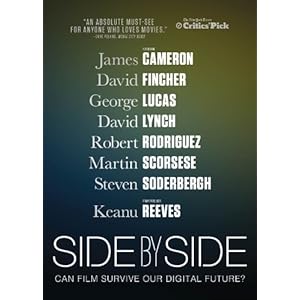
Given the trend of digital projection posts on the blog, I thought it might be pertinent to mention Keanu Reeves' recent documentary, Side by Side, on the transition of cinema from primarily 35mm film to digital both in production and presentation. Reeves speaks to a huge number of modern directors, from Martin Scorcese to David Lynch to Lars von Triers.
Salon published a terrific interview with Reeves (who is transitioning to producing and directing at this stage in his career) in September , which you can find here.
If all this talk of digital filmmaking and projecting leaves you cold, well, you can always get into the holiday spirit by watching Christopher Walken deliver the most Christopher Walken performance of all time:
I am sitting at my desk with iTunes open and listening to
Ravi Shankar. If you download his
music, one track could very easily be over 28 minutes. That’s a quarter of the time it takes to watch a
feature-length film or half of an hour-long documentary. 28 minutes could be a journey, a
distance, an entire movement. If
you watch the music instead, it’s a cinematic birth. Maybe it has five acts?
There could be a pre-amble, there could be a birth, a death, a walk in the
park, voices in the chorus, landscape unfolding from the window of a train,
beautiful love making in daylight, exquisite meals happening, contemplations,
conversations, dreams, desires of a young man named Apu? Mahatma? dances in the
court with the Indian girls, intrigue, murder, intoxications of all kinds and
then the denouement, the rest and relaxation, and sleep…for another departure
is around the corner.
David Barsamian
I don’t know much about ragas, but David Barsamian
does. You hear his voice on KGNU
and 125 other radio stations. He
is the founder and director of “Alternative Radio” and maybe you see him riding
his bicycle around town or shopping at Ideal. He never seems to age. He knows how to listen to a raga and
he knows how to talk about it.
Really. So go to him if you
need the facts. I only have the
stories the music can tell me.
Waning Crescent
Ravi passed on December 11 - that was Tuesday this
week. Tuesday was a waning
crescent at 4.6% in Scorpio. The
moonrise was at 5:11am and it set at 3:17pm. They say being born is like the rising sun and dying is like
the setting moon. Ravi was
92. It’s wonderful to live that
long, right? He died in San Diego, California. Have you ever been to San Diego? The light is soft and the air is infused with seawater.
There are rosemary plants the size of bushes along the sidewalks - unthinkable
here in tough-to-grow-rosemary Colorado. Dr. Seuss lived in San Diego. It is the land of Horton, that famous
cat with his hat, and grumpy Grinch. The flora and fauna of San Diego could
have easily inspired a doctor like Seuss.
Can’t you see Ravi’s music flowing out of San Deigo, moving
Lorax Scenery
with the
ocean air currents and slowly, magically, growing? It’s moving across the continent and kissing you with
tenderness and planting a story in your mind. It’s bidding us farewell, for now.
It’s cinematic music.
I’m not alone in re-imagining his music for the 24fps crowd.
Richard Attenborough and Satyajit Ray worked with Ravi and I’m sure Wes
Anderson’s “The Darjeeling Limited” has some roots in Ravi.
Ravi was nominated for an Academy Award for his score of
Richard Attenborough’s “Gandhi” in
1982. He lost to John
Williams, for E.T.
Satyajit Ray
He composed the music for Satyajit Ray’s “Apu Trilogy”. Have you seen these films? They are so beautiful. I mean really stunning. You watch one of his films and feel the
tremendous burden of love, death, desire, and peace. You have the realization that sadness and happiness are a
construction. You will never know
the whole story of why. It is
better to be at peace than to struggle.
You are finally allowed to say, with your whole heart, “Everything will
be ok, no matter what!” And that
is Ravi’s music too.
Ravi composed the music for “A Chairy Tale,” which was
nominated for an Academy Award for best live action short in 1957.
And of course we all know about the mutual love affair of
Ravi and George. As my sister said
in her recent FB status: “The great band in [the] sky keeps gettin' better 'n'
better... It's just down here, that it seems a bit empty...”
Ravi, I’ll be listening and watching your music. Peace to
you on the journey.